
Fancy Text Generator
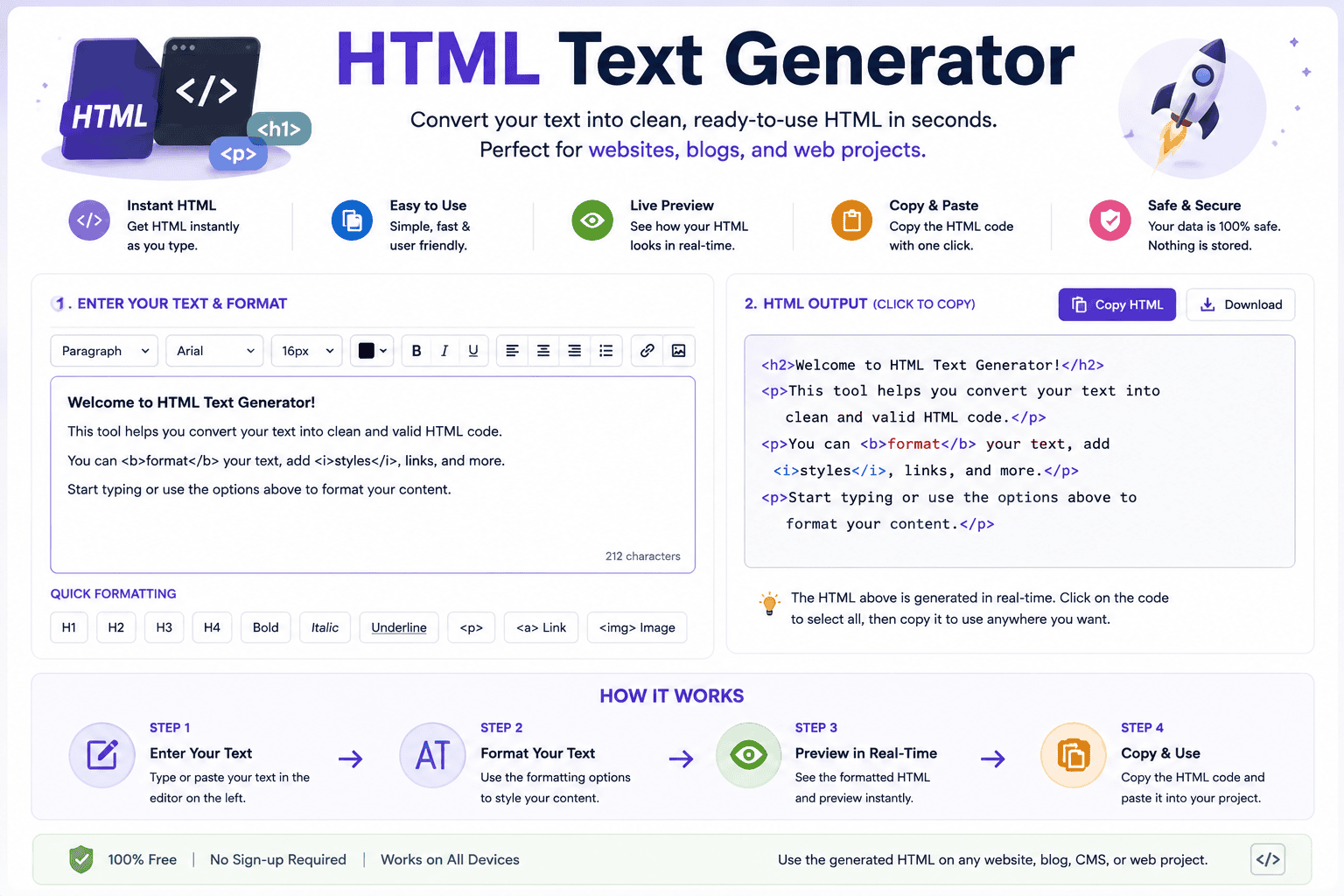
An HTML text generator turns into HTML, letting you enter text, paste content, and preview results. I find a Visual Editor useful for testing formatted content, while an HTML Editor reveals source code for adjustments.
A practical workflow can customize colors, choose fonts, make instant changes, and copy HTML for a website or application. Results combine visual control with clean markup, keeping readable HTML content to maintain, inspect, and reuse.
Table of Contents
How To Use / Creating HTML Text
Start by pasting plain text into the browser editor, then use the visual editor to adjust formatting, inspect the source editor, and generate HTML. I recommend testing each change before saving final code carefully today.
For cleaner results, view HTML, clean code, and manage tags carefully. Use find-and-replace when needed, verify attributes, then copy the generated markup into your website or email workflow without unnecessary edits. Keep browser formatting consistent.
HTML Styling / Text Customization
Effective HTML styling starts with readable choices, not decoration alone. I usually adjust colors, strokes, shadows, and gradients after checking the background, because balanced formatting keeps customized text practical across browsers and different screen sizes.
During hands-on editing, I find inline styles useful for precise changes, while classes and HTML elements keep patterns consistent. CSS properties can shape emphasis without making the generated markup unnecessarily difficult to maintain over time.
Also Read: Fraktur Font Generator – Create Gothic Text Online
HTML Editing / HTML Code Generation
Source editing lets me inspect HTML structure, adjust tags, and generate clean HTML code without leaving the browser. In practice, I often combine interactive source editing with HTML cleanup to keep revisions controlled and precise.
For larger changes, find-and-replace speeds repetitive edits, while visual HTML editing reveals how formatting behaves. I prefer testing generated source code before publishing, especially when document processing and browser editing meet in practical workflows reliably.
HTML Conversion
HTML Conversion works best when Word-to-HTML conversion preserves structure while source code remains editable. In practice, I combine conversion tools with online conversion, then inspect web content before publishing for cleaner results across real projects.
For everyday transfers, paste convert text into the browser, test the MS Word upload, and review the generated HTML code. When extra markup appears, HTML stripping can simplify output without losing essential content or structure.
HTML Cleanup / Formatting
In practice, I start with HTML cleanup before styling, removing distracting tag attributes, redundant inline styles, and unused IDs. This makes clean code easier to inspect, edit, and maintain across projects without confusion and delays.
For stubborn markup, I rely on cleanup options, find-and-replace, successive spaces, and empty tags checks. Removing unnecessary span tags improves structure, while formatting keeps source files consistent during ongoing HTML editing and review by hand.
Use Cases / Applications
Roblox games benefit from rich text applications when headers, buttons, and banners need emphasis. I use this approach for landing pages, logo text, and article headings, especially when styling matters more than elaborate design systems.
For email creation, CMS workflows, and web publishing, markup can format email signatures, pull quotes, and editorial text cleanly. It also handles event invitations, chemical formulas, mathematical notation, trademark symbols, code examples, and technical terms.
SEO / Search Considerations
Search engines generally favor standard text when evaluating pages, so I keep readable content intact while limiting Unicode styling to decorative styling. This approach protects search visibility without stripping useful HTML structure or meaning online.
For SEO-critical content, place descriptive headings and metadata around naturally written copy, then treat Unicode characters as visual accents. In practice, this makes indexing more dependable while preserving styling for readers. SEO should guide priorities.
Performance / Readability
For readable output, I favor visual clarity before decoration. Responsive design keeps generated markup usable across screens, while web-safe fonts reduce rendering surprises. In practice, optimization also improves perceived speed when pages contain styled HTML.
Performance becomes fragile when complex effects multiply. I test browser testing and mobile testing early, then check rendering quality at different sizes. Good contrasting colors on dark backgrounds preserve readability without sacrificing visual polish consistently.
Troubleshooting Common Problems
When unsupported tags or browser compatibility cause display issues, check the generated markup first. In my testing, fallback styles often solve missing text stroke, while reducing shadow blur can stabilize inconsistent rendering inside editor.
For difficult gradient stops, shorten text length and test performance before changing everything. A troubleshooting pass should isolate browser differences, compare rendering across browsers, and identify whether the issue belongs to markup, styling, or display.
HTML Editor Features
An HTML editor becomes most useful when visual editing and source editing stay closely linked. A WYSIWYG editor offers editing commands, formatting controls, and a toolbar for quick text formatting during browser editing sessions daily.
Testing shows the strongest feature set balances control panel, visual content, and editing interface while keeping cleanup controls accessible. formatting can be adjusted beside table handling, undo, and clean code, making revisions safer before publishing.
Perfect For Roblox Games
For creators, Roblox code becomes easier to polish when Roblox RichText settings are handled before testing. I have found text stroke, shadow blur, and gradient stops especially useful for game labels, menus, badges, and signs.
Good results still depend on simpler fonts, compatibility, and reliable rendering. Keep RichText enabled, test display problems early, and watch performance on mobile devices so styled text remains clear during active gameplay without distracting effects.
Preset Styles Explained
Preset styles speed up HTML text design when you want consistency before tweaking details. I often start with Basic, then test Neon, Gold, or Rainbow presets to compare visual impact across headings and interface text.
For more controlled work, combine font family, font size, and font weight choices with 3D Shadow. Roblox and Gothic options can suit game interfaces, while deliberate switching keeps customization practical rather than decorative daily projects.
Also Read: Fortnite Font Generator – Create Cool Gaming Fonts
Advanced Tips & Tricks
Advanced work starts with responsive design rather than decoration. Test contrasting colors, readability, and clarity on mobile devices, while checking web-safe fonts and rendering. Browser testing should expose weak combinations before deployment in production contexts.
For deeper control, use interactive source editing, find-and-replace, and tag management together. I also verify attribute management, clean code, and rich text after edits. During publishing, protect SEO-critical content, metadata, and standard characters for stability.
Troubleshooting Common Issues
Broken output starts with HTML cleanup problems: stray tags, attributes, or successive spaces may distort rendering. I inspect the HTML Code Editor, remove unwanted markup, then test the result in a browser before adjusting styles.
For cases, check CSS declarations, CSS, and source editor changes. images, links, and tables can introduce spacing, while AI watermarks or line organization may survive cleanup. Compare revisions carefully, and verify responsive design across browsers.
How Unicode Fonts Work In HTML
In HTML, Unicode characters carry their own code points, so text can display specialized forms without separate font files. Browsers decode those values and render the requested glyphs according to available support reliably online today.
From my testing, character-based styling travels with characters. This differs from CSS font properties because copied Unicode text can preserve its visual identity across compatible interfaces, giving practical portability when HTML is reused across platforms.
Advantages Over CSS Font Propertie
Unlike CSS font properties, Unicode characters can preserve visual treatment inside copied HTML content, making styled text portable across editors. In practice, I find this useful when consistent font appearance matters beyond local stylesheet rules.
This approach reduces reliance on external font files and complex CSS declarations. Because characters carry form through Unicode support, HTML elements can retain expressive typography across browser rendering environments, even when stylesheets change or disappear.
SEO Considerations For Unicode Fonts
For SEO, Unicode text can remain meaningful when search engines understand the underlying Unicode characters. I prioritize readable wording over decorative text, because excessive styled Unicode may weaken clarity and reduce search visibility across pages.
Use metadata, meta descriptions, Open Graph, JSON-LD strings, and SEO carefully, while keeping copy natural. From my testing, clear text styling and moderate character use support accessibility without turning important page content into ornamental symbols.
Free Vs PRO Comparison
Free access keeps browser-based editing practical, while PRO workflows prioritize advanced HTML editing, source editor control, clean HTML, and formatting precision. In my experience, this distinction matters when projects require repeatable output and reliable portability.
A font generator can provide Unicode, styled text, and strong accessibility without installation. PRO becomes valuable when heavier document processing, interactive source editing, table handling, find-and-replace, and HTML download demands exceed basic browser-based editing workflows.
The Control Panel Of The WYSIWYG Editor
A capable WYSIWYG control panel makes HTML editing feel deliberate: formatting, source inspection, find-and-replace, and clean HTML controls stay close to the canvas. In practice, this reduces friction when refining headings, links, spacing, and elements.
I switch between visual and source editor views before exporting. interactive source editing exposes unexpected markup, while browser-based controls keep revisions immediate. The best panels balance buttons with precise HTML download, making cleanup less error-prone.
Div Table Styling
A visual editor often hides how Div tables behave, yet editing commands reveal the practical structure. I use formatting controls to align visual content, adjust spacing, and keep table cells consistent across layouts.
For reliable Div styling, browser editing makes quick testing easier while text formatting stays predictable. The toolbar should expose reusable options, and the editing interface should keep structural changes visible during refinement.
Also Read: 𝐁𝐨𝐥𝐝 𝐓𝐞𝐱𝐭 𝐆𝐞𝐧𝐞𝐫𝐚𝐭𝐨𝐫 – Write in Bold Text
Other Important Features
Beyond styling, I value the visual editor for quick editing, reliable undo, and clean HTML cleaning. Practical document editing, source editing, saving, and sharing make everyday revisions easier without leaving the browser today at all.
Another overlooked strength is interactive demo testing before export. The workflow supports email HTML, AI-assisted processing, custom JavaScript processing, and export, while cleanup keeps generated markup manageable for real projects and recurring updates across teams.
Why Is This Just Perfect?
From my experience, this tool feels unusually practical because visual clarity, browser testing, and customization meet in one workflow. linear gradients, text shadow, and text stroke make ordinary content immediately more expressive without adding complexity.
I also value portability: copied text, persistent styling, and text portability reduce repetitive work, while WordPress and HTML rendering broaden everyday use. For polished pages, that balance is genuinely useful during practical content creation.
What Is Lorem Ipsum?
Lorem Ipsum is a long-established form of dummy text used when a page needs placeholder content before real copy exists. In typesetting, designers used it to judge spacing, hierarchy, and visual balance across layouts today.
Although Lorem Ipsum generation now happens instantly in a browser, its purpose remains practical: test web content, paragraph length, and printing appearance without distracting readers. I often use it to expose alignment problems early onscreen.
Conclusion
Good HTML work is less about decorative effects than dependable output. In practice, I value HTML cleaning, tag management, and attribute management because they keep generated text structured, editable, and reliable across real publishing tasks.
A practical browser workflow also benefits from copy and paste, clear text formatting, and careful cross-browser testing. When content moves between editors or platforms, these habits reduce surprises while preserving readable results and online workflow.
How Do I Convert Text To HTML?
Converting text to HTML starts with select content, then text editor work that removes unwanted formatting. In practice, conversion becomes cleaner when text conversion respects document formats, structure, spacing, and readable browser output before publishing.
Can I Paste Unicode Fonts Directly Into HTML Without CSS?
Yes, Unicode fonts can be pasted directly as characters in HTML, but the browser does not receive a new font file. The characters rely on encoded values, available glyphs, and platform rendering to appear consistently.
Do Unicode Fonts Work In WordPress?
Yes, Unicode fonts can work in WordPress because modern browsers handle Unicode directly. In practice, I check platform compatibility, text fields, HTML titles, tags, and RichText behavior before publishing decorative text across pages consistently online.
Will Unicode Fonts Show In Email Clients?
In practice, Unicode fonts can appear in email clients, but results depend on browser support, character encoding, and font loading. I test character rendering across clients because fallback behavior can change spacing, weight, and alignment.
Is This A Free Font Generator?
Yes, this tool is free to use, with web tools providing convenient browser-based text creation without a software download. From my testing, that makes quick editing practical for everyday web content and routine content tasks.
1 thought on “HTML Text Generator – Create HTML Code Online”