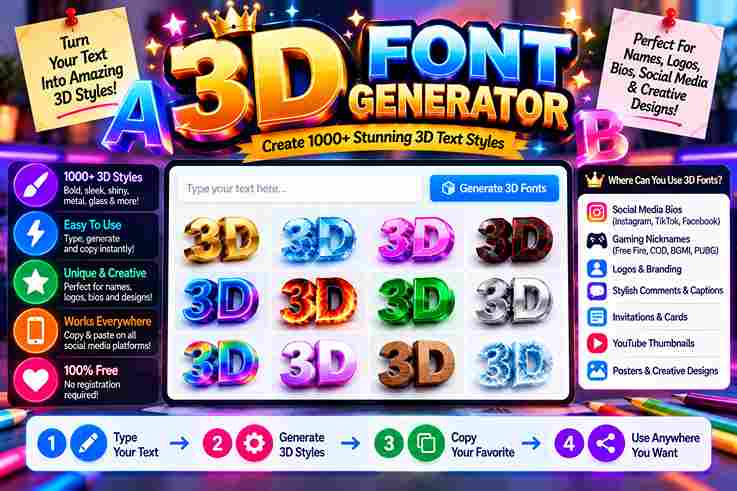
From my practical experience, a 3D font generator becomes valuable when letters gain convincing depth, lighting, and material choices without complex software. The best results begin with readable typefaces, balanced spacing, and purposeful bevel settings.
I usually test the live preview before committing, rotating the design to inspect shadow, texture, and stroke weight. A flexible browser workflow then supports rapid PNG, GLB, OBJ, or STL export for practical creative production.
Table of Contents
Export Formats / Download Options
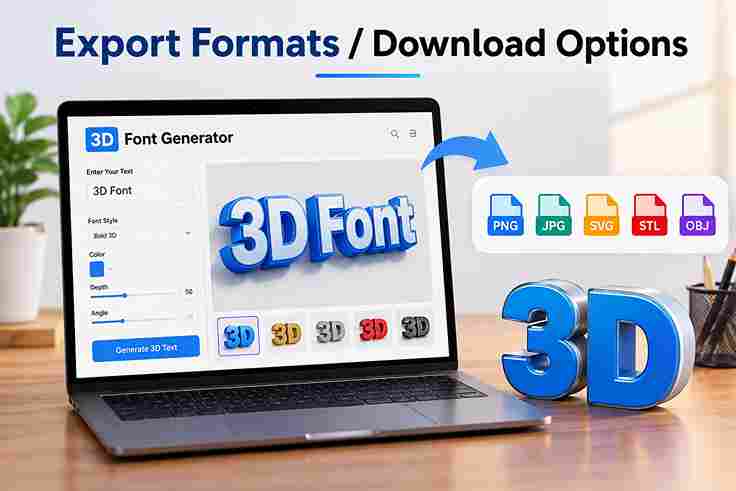
From testing, the best export format depends less on visual polish than destination. Choose Transparent PNG for layered layouts, check high resolution and size, then use the download button only after inspecting the preview toolbar.
For reusable assets, I typically retain GLB, OBJ, or STL beside a mesh file; Blender handles revisions, while Unity, Unreal, and Roblox Studio receive optimized copies after conversion, preventing repeated rebuilding across demanding production pipelines.
How It Works / Steps
Start by choosing a Style, then enter your Text and adjust colors, background, depth, and spacing. I usually inspect the live preview, because early readability review prevents weak structure before any final download or export.
Next, refine the font, material feel, and lighting controls, examine the 3D model, then select transparent PNG, STL file, or another supported format. In practice, I verify stroke thickness and production checks before saving locally.
Real-Time Preview
In practice, a preview toolbar should expose mistakes before commitment. I test raised wood letters, glossy chrome text, and cartoon sticker type at several viewing distances, watching edge clarity, depth balance, and awkward overlaps instantly.
The most useful screen response is not decorative; it supports decisions. Compare an embossed gift tag beside a product mockup, switch the reference image, and inspect legibility before download, especially when client revisions arrive unexpectedly.
Also Read: Underline Font Generator Copy and Paste
Free / No Signup / No Watermark
From my testing, the Free platform opens immediately without signup, login, a paywall, or any usage cap. Every user can shape polished designs while avoiding hidden cost, forced upgrades, and avoidable interruptions entirely during creation.
Clean exports arrive without a watermark, keeping unlimited experiments ready for clients, classrooms, or individual use. In practice, that freedom speeds iteration because nothing must be registered, purchased, removed, or corrected before sharing with confidence.
Use Cases / Who It’s For
From my experience, students, indie creators, and studios benefit most: they can build social posts, gaming headers, birthday invites, or brand mockups quickly, while testing color, contrast, and layout before committing production resources or budgets.
Practical users range from makers creating custom signs, name plates, keychains, and cake toppers to sellers developing product tags, packaging, stickers, and labels; designers can also prototype logos, videos, games, or signage without complex workflows.
3D Printing
From workshop experience, 3D Printing succeeds when makers treat typeforms as structure, not decoration. I test wall thickness, joins, and balance early, helping 3D lettering survive slicing while reducing failed prototypes and wasted filament overall.
For small studios, production workflow matters more than flashy previews. I convert sturdy letterforms into printed samples, then refine tolerances for packaging, ornaments, and event decor, giving small shops dependable, repeatable results across batches consistently.
Make 3D Text Online
Unexpectedly, the fastest route to polished lettering is often browser based. I use client-side WebGL processing to shape depth immediately, avoiding a server roundtrip while rotating and zooming until spacing, shadows, and perspective feel balanced.
Instead of designing from emptiness, I test Presets against the message first. Cute logos suit playful names, sports logo text adds competitive weight, while Barbie Pink or Dream Pop gives campaigns personality without weakening readability.
A Free Alternative To 3D Text In Photoshop
A free browser workflow challenges the belief that serious dimensional lettering requires Creative Cloud, a subscription, or desktop install. For quick campaigns, it can replace Photoshop 3D when the goal is a convincing rendered image.
That freedom has limits: a PSD with editable 3D layers still belongs to specialist software. Yet an editor link removes the conversion step for routine revisions, letting teams adjust composition, lighting, and typography quickly together.
Text To 3D Model Rendering
From production experience, the strongest Text to 3D model workflow begins with the final render, then works backward through materials, geometry, and lettering choices, producing a convincing real 3D mesh without unnecessarily bloated technical steps.
I routinely test each 3D output by rotating the word under controlled light, because attractive photoreal PBR textures cannot rescue weak three-dimensional shapes, thin strokes, tight spacing, or poorly formed inner counters during demanding rendering.
On Your Device
On your device, the practical advantage is immediate control: Chrome, mobile Safari, or desktop access lets hardware process changes locally, avoiding an upload queue, account friction, software install delays, and the wait between detailed refinements.
For quick client reviews, I prefer an online 3D text generator with real-time preview, instant results, and no install. It keeps styles searchable, preserves fine-tuning, and makes PNG export dependable for a YouTube thumbnail handoff.
Meshy 3D Text At A Glance Vs Adobe Creative Cloud Tools
In my testing, Meshy behaves like a focused 3D text creator, producing fast visual results without the layered setup usually required across Photoshop, Illustrator, and After Effects for comparable dimensional lettering workflows in one place.
Adobe’s suite offers deeper manual control, while Meshy prioritizes rendering on your device, reducing setup friction when experimenting with type. I find it stronger for quick concepts, though Creative Cloud remains better for detailed refinement.
Template-Led Workflow
Starting with presets often beats designing blindly: I select material cues, test clean metallic, and compare a preview before adjusting gradients, stroke, and lettering direction for a faster, more dependable creative direction each time consistently.
In practice, templates turn scattered experiments into repeatable decisions. Spark Joy can define streaming covers, while Rose Luxe guides soft metallic lettering; creators refine Roboto Bold, Bungee, Cozy, Studio, and export menu choices with confidence.
Popular Template Starters
I usually begin with blank canvas presets only after testing a ready-made copy; the strongest project starters expose style options, letting creators compare name signs, product labels, and personalized gifts before adjusting depth or materials.
From client work, I’ve found visually specific starters outperform generic templates: glossy acrylic text, chrome badges, and sticker-style type immediately suggest suitable signs, party decor, or craft projects, while preserving room for distinctive lettering decisions.
3D Font Creator From Image References
Instead of starting with a blank canvas, I upload clear files and use each reference to rebuild letters, fonts, and typography with controlled depth, surface cues, and recognizable proportions before refining the final 3D form.
From experience, the strongest results come from separating shape, material words, and background, then matching artwork through bitmap engraving, vector scoring, or cutting choices so every model supports its intended final product and file type.
3D Text Effect Online For Signs And Stickers
From workshop testing, a 3D text effect often succeeds when the sign reads clearly before decoration. I shape glossy raised lettering around distance, lighting, and material limits, then adapt the same structure for sticker concepts.
Rather than copying a product photo, I extract its visual style, simplify edges into vector artwork, and test contrast for Sticker Sheet Lettering. This approach produces a label, durable outlines, and social graphics for production.
3D Letter Generator For Cleaner Maker Files
From my workshop experience, a dependable 3D text workflow begins by simplifying contours before export. Clean vector paths reduce stray nodes, improve laser accuracy, and make engraving, scoring, or cut operations easier across different materials.
For production, I test mesh thickness, confirm size, and inspect printer setup before sending files to Bambu Studio or PrusaSlicer. This practical check prevents broken edges, supports reliable single-color output, and improves repeatable 3D prints.
Good 3D Font Ideas & Examples
Strong concepts often begin with an audience: cyber glow for club posters, warm luxury lettering for premium launches, or sparkly pastel text for birthday graphics. I test readability first, then refine depth, lighting, and spacing.
For less predictable results, pair playful brand words with polished invitations, or adapt title treatments into social covers. My strongest examples balance bold silhouettes, controlled shadows, and simple materials rather than excessive decoration or ornamentation.
Is It Free?
Yes, the generator is genuinely free, letting me test multiple designs without a hidden paywall, visible watermark, restrictive usage cap, or surprise cost; for routine creative work, access feels practically unlimited across projects and clients.
Can I Export/Download As PNG?
Yes—exporting a bitmap PNG works for mockups, YouTube thumbnails, TikTok covers, promo graphics, logos, and campaign pages. In practice, transparent backgrounds preserve edges, while high resolution keeps chrome-like text effects sharp on screens and print.
Can I Use This For Laser Cutting, Engraving, Or 3D Printing?
From my workshop experience, laser makers get cleaner results when characters are engraved or scored, while 3D printers need solid geometry, suitable formats, reliable slicers, and careful wall thickness before you print signage or prototypes.
Can I Customize Fonts/Styles/Effects?
Yes. I usually begin with built-in fonts, then adjust standard fonts through a style prompt, Material panel, and Environment preset. Combining 3D effects, Glow, bloom, and post-processing creates polished, customizable results without rebuilding the design.
Can I Use My 3D Text Commercially / For Products I Sell?
Generally, commercial use is often acceptable for products you sell, including Layered Acrylic Name Signs, desk plates, and personalized wall decor, but I verify font licenses, generator terms, marketplace policies, and asset ownership before production.
What 3D Model Formats Can I Export?
From hands-on testing, I export text 3D output for Blender, Unity, Unreal Engine, and Cinema 4D, then prepare production-grade meshes for a 3D printer through a slicer such as ELEGOO Cura or a 3D tool.
1 thought on “3D Font Generator – Create Stunning 3D Text Online”