
Is It Safe To Use Unicode Text For Gmail Password
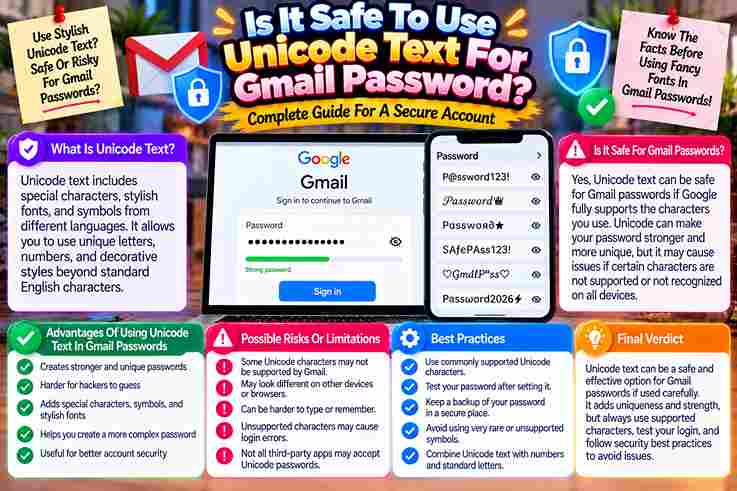
Using unicode in a Gmail password can increase character variety, but practical safety depends less on unusual symbols than on length, randomness, reliable entry, and whether every device, keyboard, and recovery flow handles them correctly. From my testing, the stronger choice is a unique password stored in a manager, with Unicode added only when it works consistently across phones and computers; otherwise, complexity creates availability problems without meaningful security gains. Security Benefits And Entropy Of Unicode Passwords In practice, Unicode can raise entropy when a password combines characters, numbers, and longer sequences, but the security benefit appears only when the service handles UTF-8 consistently and does not silently truncate or normalize input. From testing, length still beats complexity: a random, 20-character phrase is usually more secure than a short string filled with emojis, because hashing, authentication, keyboard access, and recovery workflows must remain reliable across different systems. Supporting Comment From Forest Through hands-on reviews, OWASP guidance gains value only when Sites Verify what is allowed. A platform may allow an Application to accept Emojis, including symbols beyond ordinary language, yet authentication recovery can behave unpredictably later. My recommendation remains neutral: choose passwords built from permitted, printable symbols, probably excluding unusual spaces. For security purposes, every Standard deserves clear Verification, not recycled reasons regarding what commenters are saying within a discussion section. Also Read: Are Fancy Fonts Bad For Screen Readers And Website Accessibility Supporting Comment From Edd2110 From my own testing, unicode credentials seem harder to guess, yet keyboards, locales, and recovery screens may interpret identical symbols differently. That inconsistency creates an avoidable availability problem, especially when traveling or changing devices unexpectedly. Edd2110’s point is stronger than novelty: choose a long, randomized, typable sequence instead. This raises theoretical space, but one unsupported character can block access, complicate reset, or expose implementation bugs without delivering meaningful security gain. Fencepost Security And Diminishing Returns In practice, Ignoring usability while chasing marginal strength often creates a fragile password. Unicode may raise theoretical complexity, yet device compatibility, recovery friction, and input errors can erase that edge during emergencies and lockouts alike. I have seen enforcing exotic symbols become miserable when a keyboard changed or autofill failed. Beyond sensible length, additional symbols offer diminishing returns; reliability, recovery, and consistent entry substantially outweigh decorative complexity in daily operation. Supporting Comment From Ricky Notaro-Garcia Ricky Notaro-Garcia’s section starts with usability: elaborate Unicode credentials may seem stronger, yet Gmail accepts standard ASCII input. In practice, Obscurity loses value when users must manually recreate symbols on an unfamiliar machine during access. The point is contrarian but sound: glyph variety offers little protection if the service rejects it or another device cannot reproduce it reliably. I prioritize length, uniqueness, a password manager, recovery options, and two-step verification. Supporting Comment From SBoss SBoss’s argument is practical: Unicode may increase entropy, yet password managers and reliable recovery matter more. In my experience, unusual characters can cause login difficulty when a site changes encoding or silently applies restrictive limits. The comment also supports testing before adoption. A strong, long password remains easier to enter, store, and recover across apps, whereas exotic symbols may create unnecessary inconvenience without meaningfully improving protection against modern brute-force attacks. Entropy Vs. Practicality And Length Considerations From practice, the misconception is that unusual characters automatically create unbeatable protection. Real cryptography rewards sufficient length, unpredictable structure, and broad density; a longer memorable passphrase usually offers better usability than a short, problematic sequence. In audits, I prioritize recovery and cross-device entry before chasing extremes. byte-length, keyboard access, and service compatibility matter because escaped characters or inconsistent algorithms can undermine entry, while added length keeps protection practical and dependable. Also Read: How To Write Italic Text On Whatsapp Supporting Comment From Mckenzm From practice, Mckenzm’s comment suggests Unicode may create higher complexity, yet strong passwords still depend on length, consistent bytes, and input. Extra symbols cannot rescue predictable reuse when authentication systems normalize, reject, or mishandle characters. I have seen tools like KeePass preserve unusual characters correctly, while copied text fails across older services. Mckenzm’s practical point is that added entropy matters only when every login path remains valid, recoverable, and available. Supporting Comment From Acccumulation From practical experience, I have seen extended-ASCII additions make a password feel stronger, yet a phone, PDF, or older system may reject identical input, leaving the legitimate account owner unable to log in securely later. Accumulation’s point is that attackers often exploit social engineering or password reuse before attempting brute force. Adding unusual symbols can help, but longer, memorable phrases usually reduce exposure without creating avoidable storage and recovery problems. Unicode As A Workaround For Short Password Limits When a service enforces a strict password limit, Unicode can technically expand the character range, yet I never assume it will automatically improve security. Byte handling, normalization, and account recovery may introduce consequential access problems. In practice, longer ASCII passphrases remain easier to type, store, and recover across devices. I have seen certain characters fail during login, so compatibility, availability, and support matter more than novelty when protecting important accounts. Also Read: Aesthetic Fonts for TikTok Bio and Captions: The Ones That Actually Work in 2026 CIA Triad And Availability Risks From practice, Unicode may raise password variety, yet availability often fails first: antiquated login forms, recovery tools, or keyboard layouts can reject strings, leaving users suddenly unable to access Gmail when hosts handle characters differently. Confidentiality and integrity matter, but a stronger secret is not safe if devices normalize characters differently. I advise careful testing across recovery, password managers, and sign-in paths before using Unicode, because access must remain reliable.