
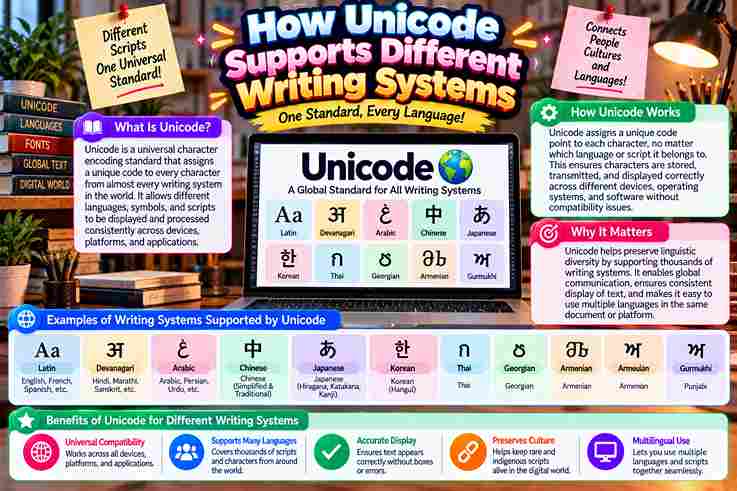
Modern software succeeds when Unicode treats every character as an abstract identity rather than a picture. In practice, this separation lets writing systems, languages, symbols, and emojis move across web applications, databases, browsers, and devices.
What matters most is not the visible glyph, but the stable code point behind it. I have seen UTF-8 prevent garbled text during transmission, while normalization forms and combining characters keep multilingual input consistently predictable.
Table of Contents
What Is Unicode?
Unicode is less about visible text than identity. The Unicode Standard assigns each symbol a unique code point, creating a stable universal character set that lets software recognize written information without depending on one language.
In my experience, Unicode becomes clearest when viewed as infrastructure: character encoding connects human writing with machines, while a broad codespace preserves room for diverse symbols, archival material, and future additions across evolving digital environments.
How Unicode Works
Text begins as code points, then encoding schemes convert those values into bytes for transmission or storage. A receiving system decodes that data, allowing the intended displayed character to appear rather than meaningless numerical information.
What users see also depends on the operating system, browser, and app interpreting Unicode text consistently. Practical testing shows Unicode works best when every layer preserves the rules from input through processing, transfer, and rendering.
Also read: Cursed Text Generator – Ultimate Chaos
How Text Travels In Computers
When text leaves an app, computers do not move visible letters; they move numbers. Each character becomes a Unicode code point, then UTF-8 encoding turns that value into bytes suitable for storing, transmission, and reconstruction.
I trace bugs by checking encoding schemes at boundaries. A browser, API, and database must interpret Unicode strings consistently; otherwise wrong encoding creates Mojibake, special characters break, or visually identical text compares differently in practice.
Multilingual / Multiple Scripts Support
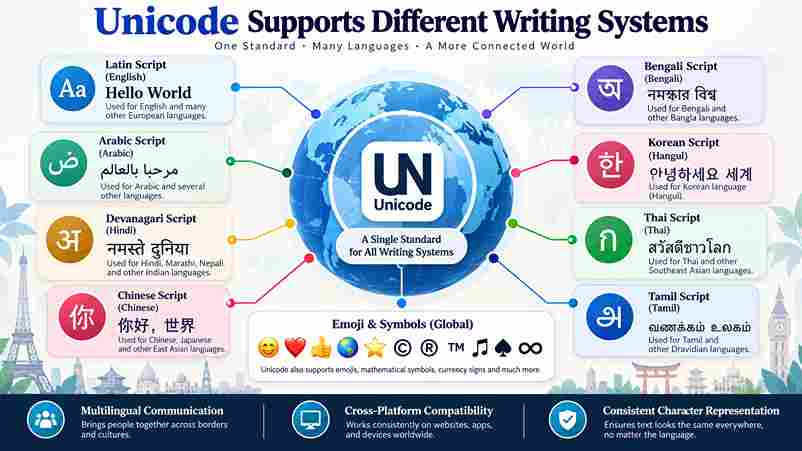
In practical projects, Unicode matters because abugidas, syllabaries, and major writing systems can coexist inside one application. I have seen Arabic and Devanāgarī content remain structurally distinct while sharing one interoperable code model underneath reliably.
Support becomes clearer when abstract entities are separated from visual representations: Unicode identifies text, while fonts and shaping determine appearance. That distinction helps CJK unified, compatibility ideographs, and orthographic rules remain usable across software reliably.
Combining Characters / Diacritics / Normalization
Unicode can handle modifying characters without assigning every visual form a separate code point. A base character may receive combining diacritical marks, allowing software to construct equivalent glyphs while preserving flexible text representation across languages.
Normalization matters because visually identical text may use precomposed versions or separate diacritic combinations. In practice, consistent normalization improves comparison, search, and conversion, especially when older legacy encodings interact with modern stored multilingual Unicode data.
Emojis And Symbols
Unicode treats characters such as emoji, arrows, currency signs, and technical symbols as encoded identities rather than pictures. In practice, a universal standard lets the same symbol travel across platforms, applications, and devices with meaning.
Emoji sequences become especially interesting because one visible glyph may involve multiple bytes, variation selectors, or joined code points. I usually verify string length behavior before processing, since appearance and encoded structure can differ significantly.
Also Read: Tiny Text Generator – Instantly Stylish
Databases And Data Storage
In production databases, store text consistently rather than trusting defaults. I have seen database collation issues break sort behavior, alter comparisons, and create text corruption when systems exchange records through multiple encodings reliably across services.
Reliable storage begins with a universal character encoding standard and deliberate encoding text choices. Using UTF-16 or UTF-32 appropriately preserves character representation, while normalization helps differently encoded characters remain searchable, comparable, and stable over time.
Text Processing In Programming
In programming, Developers often discover that Unicode problems begin where ordinary string logic looks correct. Python makes digital text convenient, yet len(text), encoding choices, and surrogate pairs can still change how applications measure user-visible characters.
I usually test normalization before comparing multilingual input because accented letters may have multiple ways of representation. Using normalize routines across a codebase keeps multilingual applications predictable, supports consistent representation, and reduces subtle processing errors.
Common Pitfalls Developers Face
From production debugging, I see recurring failures when developers forget to encode utf-8, mishandle rare characters, or compare visually identical text before unicodedata.normalize. These oversights quietly break search, validation, sorting, stored names, and user input.
Another trap appears when teams treat every writing system alike. A misplaced surrogate pair, weak script-shaping technologies, or incomplete storage settings can corrupt multilingual content, reduce cross-platform consistency, and make interfaces fail for users globally.
Advanced Tips For Devs
In production, I treat Python and JavaScript text handling as a boundary problem: one character may look visually, yet incorrect string lengths appear when code assumes bytes equal characters; test and compare correctly in practice.
For resilient systems, validate ASCII fallbacks, preserve diacritical marks, and keep multilingual content in memory-efficient paths. I also test Arabic, Devanagari, Cyrillic, and Emoji input across web environments before data transmission reaches users without corruption.
Also Read: Fabulous Letter F Fonts You’ll Love Using
Why Unicode Matters
Unicode matters because global digital communication depends on a dependable system that lets languages and new characters coexist. In practice, this flexibility protects multilingual products from fragmented legacy encoding system choices and supports forward compatibility.
I value Unicode most when software moves between Windows, Java, apps, databases, and the World Wide Web without losing meaning. Its foundation gives each character a unique number, helping developers manipulate text safely across languages.
Using Unicode In SMS
In SMS, Unicode helps multilingual messages survive transmission without losing characters, giving users a consistent display across phones. In practice, this matters when one conversation shifts between languages and reaches a different device abroad reliably.
SMS handling also exposes an efficiency tradeoff: Unicode characters can consume more message capacity than legacy text. Understanding 8-bit units and a 16-bit unit helps developers plan segmentation while keeping services backward compatible across carriers.
Benefits Of Unicode
From practical development work, Unicode’s biggest benefit is internationalization: one system supports English, Hindi, Japanese, Chinese, Hebrew, and Indic languages, reducing conversion friction while exchanging data internationally and making interfaces more inclusive across modern platforms.
Another advantage appears in storage and messaging: encoded characters preserve scripts, alphabets, symbols, and a smiling face consistently, while UTF handling simplifies text representation, prevents language-specific breakage, and makes SMS or databases more versatile globally.
Scripts Covered / Scope
Unicode’s range spans U+0000 through U+10FFFF, mapped across 17 planes numbered 0 to 16. In practice, Plane 0, the Basic Multilingual Plane, contains many commonly used characters, while supplementary planes extend coverage beyond routine alphabets.
From projects I reviewed, the BMP supports a multitude of scripts, including Latin, Arabic, and Devanagari; Han unification, Unihan, thousands of symbols, letterforms, and ligature forms broaden i18n across the globe without separate encodings today.
Also Read: Preppy Fonts Generator ✨ Free Copy & Paste
Codespace And Planes
Unicode’s codespace becomes easier to understand when viewed as a structured address system. Each code point uses a hexadecimal number, while planes organize ranges efficiently, letting modern and historical writing systems coexist without collisions today.
From practical encoding work, plane boundaries matter when handling characters beyond the Basic Multilingual Plane. Values beginning near U+010000 rely on larger representations, helping software support 172 scripts, symbols, and specialized academic contexts consistently today.
Combining Diacritical Marks & Precomposed Characters
Unicode handles accents flexibly: a letter may appear as one precomposed character, or as base characters followed by combining marks. In practice, this lets keyboards, fonts, and applications represent equivalent text through internal sequences reliably.
Normalization matters because visually identical strings may use separate code point arrangements. I check these distinctions during text processing, since modifications can affect searching, comparison, filenames, and database matching even when displayed characters look identical.
Han Unification
Han Unification lets Unicode represent shared Chinese, Japanese, and Korean ideographs through common code points, while fonts preserve regional shapes. In practice, this reduces duplicate encoding and supports multilingual text across Programming languages and databases.
I have found Han Unification works best when developers separate character identity from visual appearance: Unicode assigns ideographs, while OpenType fonts select localized glyphs, allowing one encoded text stream to display culturally appropriate forms reliably.
Ligatures And Complex Scripts (Arabic, Devanagari)
In Arabic, Unicode stores each letter as a character rather than prescribing its glyph. Rendering engines apply this type of contextual transformations, joining forms and producing ligatures, so text displays correctly across fonts and platforms.
Unlike a Latin letter, Devanagari characters such as क and U+0915 participate in shaping rules, combining consonants and vowel signs into clusters. In practice, software must support Unicode natively so logical order becomes readable text.
Encoding Forms (UTF-8, UTF-16, UTF-32)
In practice, UTF-8 stores A as 0x41, while the code point U+0041 stays conceptually unchanged. Its variable-length design reduces memory usage for ASCII-heavy text and still represents every Unicode character without changing assigned values globally.
For 🙂, code point U+1F642 becomes bytes 0xF0, 0x9F, 0x99, 0x82 under UTF-8. UTF-16 uses surrogate code units, while UTF-32 stores one 32-bit unit; I inspect binary form when diagnosing cross-platform encoding mismatches in production.
Also Read: Free Text Art Generator
History Of Unicode
Unicode emerged because incompatible encodings made multilingual computing unreliable. Systems such as American Standard Code for Information Interchange handled limited repertoires, so engineers pursued one universal standard that could consistently represent writing systems across platforms.
From early consolidation efforts, Unicode continued to evolve as new scripts, symbols, and digital practices appeared. By 2008, its expanding adoption showed how a shared character framework could replace fragmented encodings without discarding existing ones.
Conclusion
Unicode proves its value when a standard carries a wide range of scripts through digital conversations, databases, and text messages. Unlike standard SMS limits tied to a 7-bit character set, Unicode preserves detail across platforms.
Its durability reflects collaboration: the Unicode Consortium, building on work from Joe Becker, keeps expanding coverage while the Ideographic Research Group addresses contested aspects, and tools such as Graphite and AAT support complex rendering today.
How do 0xE0, 0xA4, 0x95, А, U+0410, and a 32-bit unit relate to Unicode encoding?
Unicode assigns unique code points to characters from different writing systems. For example, U+0410 represents the Cyrillic letter А, while byte sequences such as 0xE0, 0xA4, 0x95 can represent encoded characters in UTF-8.
How do Slack, Discord, standardising emojis, and the thumbs-up emoji demonstrate Unicode support for symbols?
Unicode provides standardized code points for emojis and symbols, allowing platforms such as Slack and Discord to display the same basic characters consistently. This standardization helps users communicate across different devices, applications, and operating systems.
Why can the Latin alphabet, message space, maximum characters, 160, 70, spend, and invoice matter when using Unicode in SMS?
Traditional SMS using the Latin alphabet can often contain up to 160 characters, while Unicode messages may be limited to approximately 70 characters. Reduced message space can increase message segments and therefore affect messaging spend or an invoice.
How do integers, 1114111, liturgical scripts, September 2025, and the IRG explain Unicode’s scope?
Unicode represents characters as integers within a codespace extending to decimal 1114111. Its scope includes modern, historical, and liturgical scripts, while groups such as the IRG contribute to work involving unified East Asian ideographs.
How did Xerox, Character Code Standard, XCCS, the 1980s, 1987, Apple, Lee Collins, Mark Davis, California, 3 January 1991, incorporated, published, and October shape Unicode history?
Unicode emerged from efforts during the 1980s to create a universal character system. Work associated with Xerox, Apple, Lee Collins, and Mark Davis helped develop the concept, eventually leading to the Unicode Consortium and published standards supporting multilingual computing.
1 thought on “How Unicode Supports Different Writing Systems”