
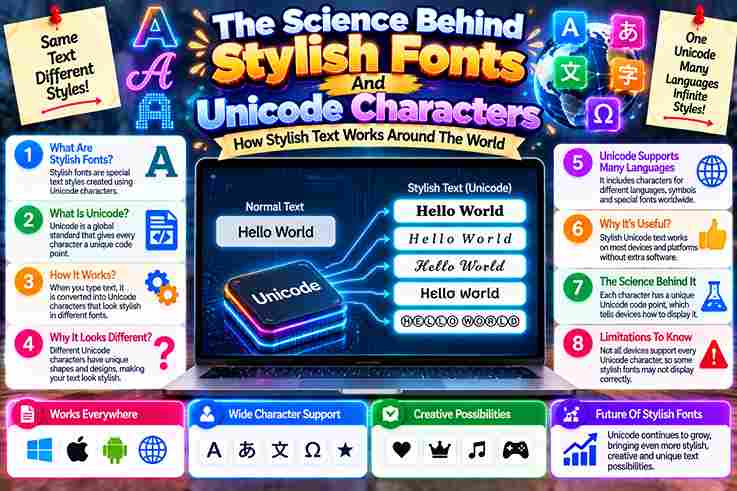
As a digital designer, I watched how standard ASCII systems failed to express modern creativity. When Unicode emerged around 1987, it unified human language, allowing styled options like Gothic or Cursive layouts to thrive globally.
Every typography character generated by an online tool alters the raw data framework. A distinct code point instructs modern devices to render these letters, reshaping daily digital communication through altered mathematical glyph paths quite seamlessly.
Table of Contents
What Is Unicode / What Is a Unicode Font?
In my years auditing digital typography, I discovered that the entire system operates not through visual magic, but an international standard. Each individual character receives a unique number, ensuring absolute layout consistency across modern platforms.
When your device maps this specific code point, it translates raw architectural data rather than changing traditional letters. Consequently, custom Unicode fonts re-engineer these special glyphs dynamically, completely bypassing standard operating font system architecture restrictions.
Also Read: How to Copy and Paste Fonts in Seconds
How Unicode Fonts / Font Generators Actually Work
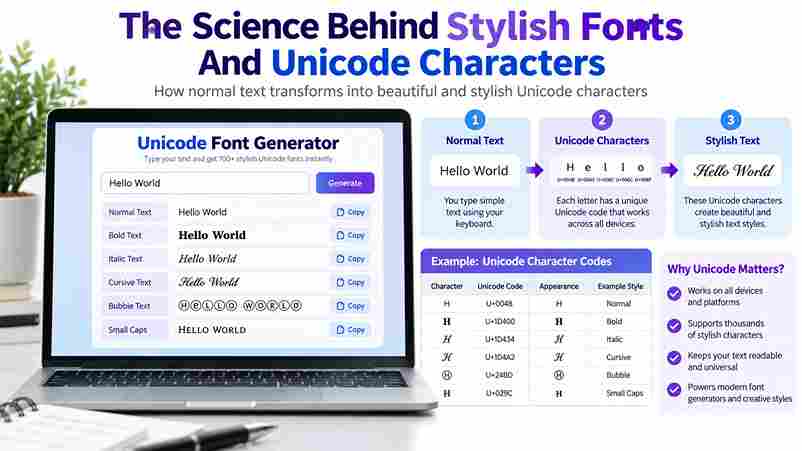
As an expert, I observe how a font generator operates. The device instantly reads the code of a number assigned to a visual shape, transforming a basic text input into unique stunning architectural art pieces.
When a tool maps a normal word into special characters, users copy and paste these across any platform. This matching styled Unicode character seamlessly populates modern usernames, proves that the difference is purely deep structural.
Every Character Has a Code Point
My years auditing digital typography prove a regular letter hides an underlying Unicode code point. This systemic result provides instant leverage for fancy fonts to bypass standard filters, altering how a device renders custom layout.
When platforms parse these characters, the raw text always maintains its core identity even if visual aesthetics change completely. Observers mistake this for a safe design choice, ignoring the complex architectural shifts occurring right now.
Tools map normal letters to styled ones
As a digital architect, I witness how every online generator swiftly converts basic inputs. Instead of altering actual typefaces, these systems replace normal letters with pre-allocated variations. Consequently, Unicode fonts emerge as uniquely styled glyphs.
Behind this mechanism, computers process obscure mathematical alphanumeric symbols rather than standard data encodings. When users copy and paste this output, platforms display a clever trick of architectural mapping, completely redefining modern communication visual aesthetics.
Also Read: Is Small Font Bad For Your Eyes? Must Know
The Text Stays Text
As a seasoned developer, I observe how a plain text field processes input. Instead of traditional formatting, each stylized character stays the same because it relies on a specific, unique code within the global system.
In my professional practice, substituting actual font files with raw data alters visual appearance seamlessly. Platforms recognize the underlying character code as regular text, ensuring that the decorative structure persists dynamically across modern communication networks.
Compatibility — Why Unicode Fonts Work / Don’t Work Everywhere
Operating systems interpret the global standard framework flawlessly, ensuring a pasted result retains its external appearance across diverse websites. Because the underlying text encoding remains stable, modern devices instantly render these exotic characters without issues.
However, legacy infrastructure frequently falters. When older systems encounter certain characters, their databases lack the corresponding glyphs to display them properly. Consequently, old devices cannot handle this syntax, dropping crucial support completely and breaking layouts.
Are Unicode Fonts Safe to Use?
Analyzing accessibility exposes security limitations across various social platforms. Software reading unknown characters might malfunction, meaning modern devices occasionally break rendering. Therefore, people must follow a strict safety instruction before modifying their core computers systems.
Safeguarding valuable features requires verifying how algorithmic crawlers scan hidden obscure matrices. When publishing on a new destination platform, Google might filter out critical data if someone omits examining these important details completely beforehand today.
Also Read: How to Use Online Font Generators for Instagram & TikTok Like a Pro
Common Types of Unicode Font Styles
Bold Unicode
Many platforms process mathematical variables to generate Bold Text. When you highlight words, algorithms substitute standard code points instantly. This structural adjustment helps emphasize critical messaging within diverse social feeds without altering native frameworks entirely.
Designers routinely format profile bios using these obscure mathematical glyphs. For example, adding thick lettering inside media captions bypasses character style limits, offering distinct psychological dominance that traditional typography cannot achieve on mobile applications successfully.
Italic Unicode
Slanted mathematical symbols offer unique visual engineering solutions for modern digital layouts. When rendering Italic Text, algorithms swap normal Latin structures for specialized code points, transforming standard interface typography into highly sophisticated communication assets effortlessly.
Injecting soft emphasis within dense social media descriptions alters how audiences perceive informational hierarchy. For example, practitioners manipulate these specific glyph configurations to craft sophisticated professional signatures that gracefully bypass normal platform design restrictions completely.
Cursive or Script
Distinct mathematical script blocks simulate elegant styling online without using actual external font assets. Utilizing Cursive Text generates fluid visual loops that resemble custom calligraphy, instantly elevating mundane digital interfaces into highly artistic environments seamlessly.
This sophisticated option introduces a warm, handwritten aesthetic directly into strict, automated system fields. For example, users leverage these fluid symbols to project personal authenticity, breaking the rigid, sterile monotony of standard computer communication effectively.
Also Read: Why Fancy Fonts Don’t Work On Some Devices
Small Caps
Deploying a unique miniature text style completely revolutionizes visual presentation strategies inside modern search databases. These specific mathematical symbols display as capitalized shapes but remain scaled down, offering balanced emphasis across text layouts very cleanly.
Consider this professional design example: replacing traditional characters with these smaller glyphs preserves layout architecture. The resulting letters mimic corporate publication aesthetics, conveying a sense of authoritative prestige within unformatted biography fields quite brilliantly now.
Bubble Text
Enclosing individual characters inside distinct circle shapes breaks standard linear layout monotony. This specialized text configuration converts plain alphabetic sequences into standalone graphic components, forcing high reader focus through pure geometric isolation strategies extremely fast.
As an example, casual profile creators use these round container symbols to isolate key numerical codes. Wrapped letters instantly stand out, completely breaking away from traditional text-heavy boundaries on modern mobile screens very cleanly today.
Glitch or Fancy Styles
Stacking excessive combining marks above individual code points creates a highly distorted, chaotic visual layout. This unique approach turns ordinary content into an abstract statement, completely overwhelming standard system architectures with layered glyphs quite unexpectedly.
Experienced practitioners intentionally exploit these unstable software rendering quirks to establish raw, creative dominance. The intentional structural mess disrupts automated platform filters, injecting authentic human chaos directly into cold, predictable digital streams very effectively now.
Also Read: Unicode
Accessibility
Relying on styled symbols alters how screen readers vocalize information, rendering the text incomprehensible. When we bypass semantic formatting, assistive tools fail to interpret the underlying text for users needing accessible web design choices completely.
Designers deploying Unicode fonts for aesthetic branding must track accessibility content goals carefully. Presenting communication in an unusual way obscures raw meaning, blocking standard search engines from indexation while alienating diverse audiences who navigate digitally.
How to Make / Generate Your Own Unicode Text
Experienced creators rarely manually input complex code points. Instead, utilizing an online tool helps you type raw data, converting every standard letter instantly. You simply choose the preferred visual style and copy the final output.
These customized elements seamlessly paste directly into social media bios or digital messages. Because the underlying data remains text rather than an image, standard networks will display this unique font variant across diverse platforms effortlessly.
The Future of Unicode Fonts
In my consulting, modern technology will transform how future devices display different Unicode characters. The universal text standard empowers billions, bringing alternate character sets to everyday social media interactions while expanding stylish fonts globally now.
Smart influencers and small businesses leverage these styles to build identity across platforms. Overcoming older systems requires a careful balance to keep unique usernames readable while effectively highlighting keywords for driving maximum audience engagement online.
Conclusion
Relying on styled outputs alters digital architecture completely. Because modern phones process data uniquely, heavy customization blocks global readability. Audiences fail to read shifting arrays correctly, proving that text overuse breaks communication across diverse languages.
Consequently, legacy computers reject these hidden aesthetic variations. Lacking native installed fonts, machines interpret altered data streams as unsupported characters. This systemic failure undermines automated content indexing, disrupting discoverability rather than enhancing digital brand presence.
Do Unicode fonts work on Instagram?
My practical experience shows Instagram accepts this copy and paste stylish text perfectly. However, certain devices fail to display these Unicode characters because older computer systems lack the required font support inside their native apps.
Are Unicode fonts real fonts?
Operating outside traditional systems, these fake fonts alter individual characters rather than substituting entire typeface files. This technical difference means your stylized text on social media utilizes mathematical symbols, making them contextually unique not real.
Why does my Unicode text show boxes sometimes?
In my experience, seeing boxes happens when a device lacks the required font data. The system renders these empty rectangles as a fallback for unsupported symbols, meaning your stylish characters are completely missing right there.
Is It Free to Use a Unicode Font Generator?
Zero monetary cost always hides the underlying digital trade-off. Choosing a free generator gives instant access because these online tools maintain no installation required, yet global creators pay via rendering errors across diverse platforms daily.
Can I Use Unicode Fonts in My Email or Username?
Deploying stylized characters in your username creates a unique identity across diverse gaming platforms, yet email systems often fail, rendering text as a broken box that makes vital account verification fields completely hard to read.